
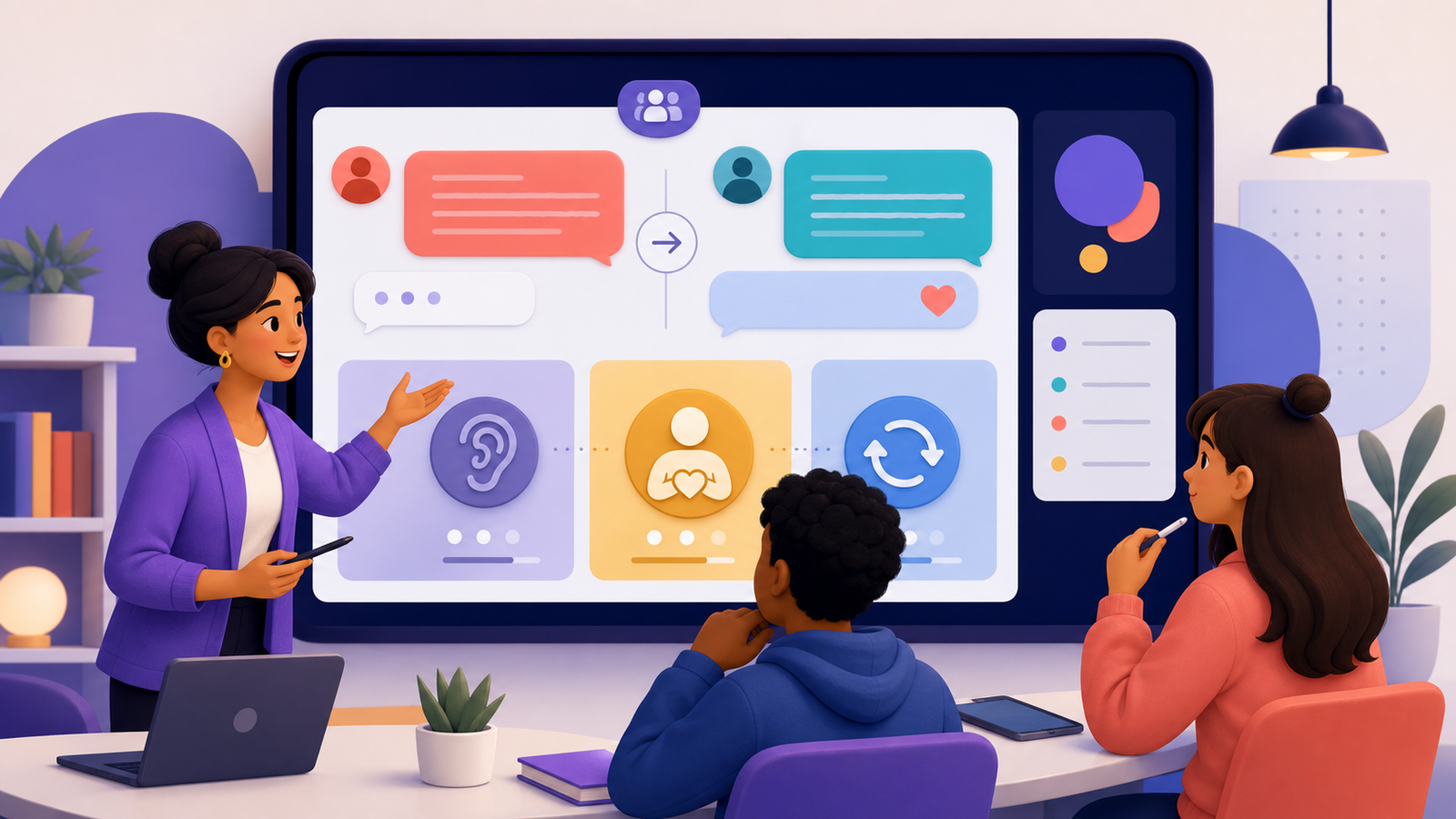
Feedback is easier to discuss when learners can slow down a conversation, examine each message, and compare alternative responses. A chat mockup creates that pause, but it must be designed carefully. A public classroom example should never reproduce a real student conflict, grade, disability, private message, or identifiable mistake.
This case uses three fictional identities: teacher Ms. Lin and students Asha and Leo. They are reviewing a fictional group-project slide. The learning goal is to replace vague judgment with a specific observation, explain its effect on the reader, ask a useful question, and agree on one revision. The scenario is teaching material, not a record of real students.
Create the fictional messages in the Chat Simulator editor and keep the accompanying lesson objectives and transcript as selectable page text.
1. Write a narrow learning objective
“Give better feedback” is too broad. This exercise asks learners to produce one response with four parts: a neutral observation, a description of impact, a clarifying question, and a practical next step. The teacher can see whether each part is present and discuss why it helps.
The task does not evaluate personality, popularity, or writing style unrelated to the objective. A narrow standard reduces bias and helps learners revise without feeling that their identity is being judged.
- Describe what is visible without guessing intent.
- Explain how the issue affects understanding or the shared goal.
- Ask a question that invites missing context.
- Suggest or agree on one manageable revision.
2. Build a safe fictional context
Asha and Leo created a slide explaining a recycling process. One diagram uses three arrows but does not label what changes between steps. The issue is ordinary, low stakes, and directly connected to the learning objective. It does not imitate a known student submission.
Use fictional names or role labels, original avatars, and invented work. If learners create their own examples, tell them not to upload classmates’ private messages, grades, health information, disciplinary records, or work without permission.
3. Compare an unhelpful response with a useful one
The first version says, “This slide is confusing. Make it better.” It provides no evidence, does not explain what the reader cannot follow, and gives no realistic direction. The teacher should analyze the wording without labeling the fictional speaker as rude or careless.
The improved version focuses on the artifact and invites collaboration. Learners can identify which words correspond to observation, impact, question, and next step.
- Asha: “I can see three arrows, but the material at each step is not labeled.”
- Asha: “I am unsure what changes from collection to processing, so I may explain the sequence incorrectly.”
- Asha: “Were the labels removed to keep the slide simple?”
- Leo: “Yes. I wanted less text, but the meaning became unclear.”
- Asha: “Let’s add one short label below each arrow and keep the longer explanation in our speaker notes.”
- Leo: “Agreed. I will revise the labels, and you can check the sequence once more.”
4. Use playback to discuss interpretation
Pause after each message and ask learners what information became available. Before Leo answers, several explanations are possible. The question prevents Asha from assuming that the missing labels came from laziness or lack of knowledge.
Playback also reveals tone and pace. If the next suggestion appears immediately after the question, learners may miss the value of listening to the response. Add enough time for reading and reflection rather than using fast animation for excitement.
5. Provide facilitator prompts, not a hidden answer
A facilitator guide should include the objective, the four feedback parts, likely misunderstandings, and questions for reflection. It should not require learners to reproduce one exact sentence. Several responses can meet the standard while sounding natural for different speakers.
The teacher can ask what would change if the deadline were close, if the feedback occurred in a group, or if the creator disagreed. These variants deepen judgment without exposing a real class conflict.
- Which words describe evidence rather than intent?
- What impact is stated, and whose perspective does it represent?
- Does the question genuinely allow another explanation?
- Is the next step small, shared, and possible?
- How could the response be shorter without losing respect?
6. Create alternative branches
One branch can show Leo explaining that the labels will appear through animation. Asha might then suggest adding a static version for readers who cannot view motion. Another branch can show limited time, requiring the group to prioritize the most important label.
Branches should teach different decisions, not punish learners for failing to guess the teacher’s preferred phrase. Explain the tradeoff and keep consequences proportionate to the classroom task.
7. Assess evidence and reflection
A short rubric can mark each feedback component as missing, emerging, or clear. Add a reflection question asking learners what they changed after seeing the other person’s reply. This values listening and revision, not only the first message.
Do not publish rankings or use the exercise to infer a learner’s character. Classroom data requires appropriate access controls, retention, and institutional practices. The public blog example should remain entirely fictional.
- Observation refers to visible work.
- Impact is specific and not exaggerated.
- Question invites relevant context.
- Next step is practical and collaborative.
- Revision responds to new information.
8. Make the exercise accessible and inclusive
Provide the dialogue as selectable text, use readable contrast, identify speakers with names as well as color, and allow sufficient processing time. Learners should be able to participate without performing a sensitive personal story.
Offer options to write, speak, or review a prepared response when appropriate. Avoid assuming that eye contact, rapid replies, or one communication style is the only sign of respect. Evaluate the stated learning evidence instead.
Frequently asked questions
Can real student work be used? Only with appropriate permission and context; a newly invented artifact is safer for a public example. Should the role-play include conflict? Mild disagreement can support learning, but humiliation, threats, and identifiable incidents are unnecessary. Can AI score the responses? Automated assistance may identify patterns, but a qualified educator should review context, bias, privacy, and the limits of any score.
Final lesson checklist
- The learning objective is narrow and observable.
- Identities, work, and dialogue are fictional or properly authorized.
- The scenario analyzes messages rather than judging people.
- Alternative responses can satisfy the standard.
- The transcript, contrast, and timing support accessibility.
- Assessment includes listening and revision.
- No private student information appears in the public asset.